Submarines may seem like a very modern invention, but the roots of the concept date back as far as 332 B.C.E., when Alexander the Great is said to have had a glass barrel constructed that he could use to go underwater and study fish up close. The first clear, scientific documentation on the topic of submarines would come much later, in 1578, when English mathematician William Bourne published Inventions or Devises. In this book, he explained how an enclosed vessel could be made to sink in the water and then rise again by expanding and contracting its volume. Inventors would build on this work to create the first submarines.
The First Submarines
Dutch inventor Cornelius Drebbel is credited with building the first submerged craft that could be propelled through the water in 1620. The Drebbel I was an enclosed rowboat equipped with pigskin bladders that could be filled with water to submerge the craft and emptied to raise it. Others picked up his idea and ran with it, developing increasingly sophisticated submersibles, most of them with a porpoise-like shape. All of these were human-powered in some way. It wasn't until 1863 that the first engine-powered submarine would be launched. This craft, the Plongeur, was developed by the French Navy and used compressed air to power its engine. While the craft was very hard to steer and quite slow, it set the stage for the creation of modern submarines.
The Emergence of Submarines as Military Tools
The French weren't the first to see the possibilities in submersibles for military use. In 1775, American colonist David Bushnell built the first successful military submersible, called the Turtle, which saw action during the Revolutionary War. This craft could have water pumped into and out of it to make it rise and fall. It was the first submersible to attack a ship, attempting to sink the HMS Eagle; however, it failed. But attempts at submarine warfare would return with the onset of the Civil War, in which both sides developed such craft. The Union's Alligator, the first Navy sub, was lost in a storm while being towed to Charleston for deployment; the Confederacy had a handful of submersibles, with the most famous being the Hunley. In 1864, it would become the first submarine to sink a ship, taking down the USS Housatonic, although it also sank shortly thereafter.
Modern Military Submarines
Irish engineer John Philip Holland is widely credited with developing the modern military submarine, working in the late 1800s on projects for both the U.S. Navy and the Royal Navy. Holland was the first to build a sub with an internal combustion engine as well as an electric motor and battery. In 1900, the U.S. Navy purchased his Holland VI, renaming it the USS Holland, and ordered seven more. The Royal Navy, which had previously viewed submarine warfare as underhanded, changed its mind after a demonstration of the capabilities of Holland's subs, commissioning its own five-boat fleet; the first of these to be put into service was the HMS Holland 1. Soon, other nations were building and deploying their own military submarines.
Submarine Warfare in World War II
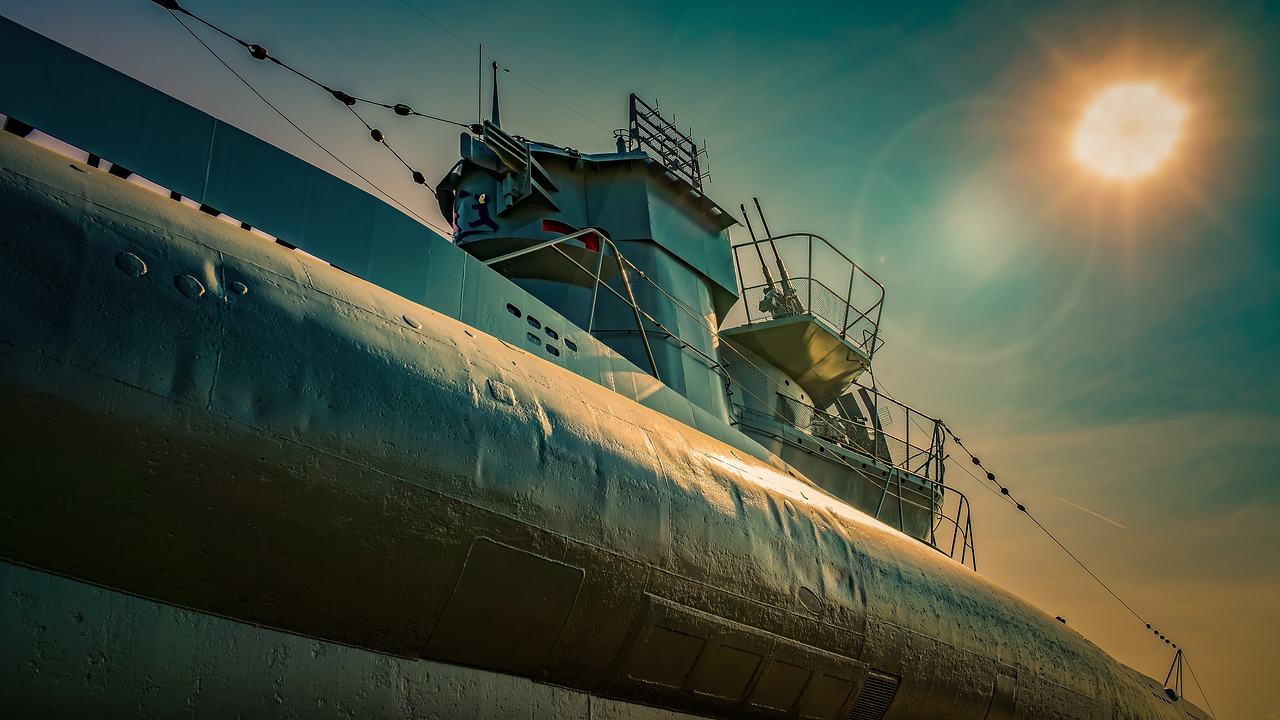
The Germans brought submarines to the forefront during World War II, using subs called U-boats as a major part of their military strategy. U-boats carried fuel tanks that allowed them to run for up to two months before needing to refuel, and they could dive up to 650 feet. German U-boats cruised Atlantic shipping lanes, targeting and sinking Allied supply ships. Attacks by German U-boats were very successful, sinking more than 3,000 Allied vessels over the course of the war. But in 1943, the Allies managed to turn the tide, attacking and sinking hundreds of German subs while greatly decreasing losses to their own ships.
The Cold War and Beyond
Once World War II ended, the Cold War began, bringing a new era of military submarine use and evolution. Most subs were now outfitted with a snorkel-like mast that would allow the vessel to better hide itself beneath the waves. Radar technology could help to find hostile subs, and radar and sonar helped military subs to avoid attack as well as underwater obstacles. In 1955, the United States launched the first nuclear-powered sub, the USS Nautilus, which could stay underwater longer and travel faster. Subs were also now equipped with missiles. Many military subs were put into service as deterrents against attacks by both the United States and the U.S.S.R.
Today, submarines still play key roles in helping to keep nations safe, carrying out surveillance operations and acting as nuclear deterrents. They are also used to stealthily deploy special forces and extract troops from hostile environments. And subs also have plenty of non-military uses as well, playing roles in scientific research and even underwater tourism.
Additional Resources
- A Short History of Submarine Development
- Nine Ground-Breaking Early Submarines
- Alexander in the Bathysphere
- Evolution of Submarines
- Drebbel's Submarine
- Bushnell's Turtle
- Cruising the Seas
- All About the Hunley
- The Story of the Holland Submarine
- USS Alligator: Past and Present
- Submarines in World War II
- The U-Boat Campaign That Almost Broke Britain
- Submarines During World War II
- History of the USS Nautilus
- United States Submarine Capabilities